

Floor Space Index is a highly technical instrument whose connotation goes far beyond a mere number. Urban land is a resource that cannot be renewed. As cities develop vertically and horizontally, governments’ and planning authorities interventions become very critical and must ensure that the development is carried out in a controlled, sustainable, and legal manner. Statutory planning instruments such as the FSI are now indispensable.
It lays down the physical shape of cities, impacts the valuation of real estate, and regulates the efficiency of land use. For any developer of projects, it is truly the FSI that gives the feasibility of development. For a buyer, it impacts density, amount of amenity space, and livability. For an investor, FSI has direct implications for the potential of land and its appreciation over time. Anyone transacting real estate must have a clear understanding of what FSI means in real estate, how it is measured, and why it is important.
The blog will provide an in-depth, structured account of floor space index, how it is calculated, regulatory aspects, and its application in various cities, with reference to the real estate scenario of India.
See also: Top Real Estate Developers in Bangalore Market Insights
Floor Space Index (FSI): Meaning and Full Form
- The defined maximum area of construction permissible on a plot of land is called the FSI in real estate.
- The FSI is Floor Space Index.
It is defined as the ratio between
- The total built-up area of all floors in a building and
- The total area of the plot on which the building is constructed
In many international planning systems, this ratio is referred to as FAR (Floor Area Ratio). In the context of Indian real estate, the terms FSI and FAR are used interchangeably to define the same legal concept.
What Is the Floor Space Index?
The FSI full form is a Floor Space Index.
The floor space index is defined as:
It is the ratio of the total area of built-up area permissible for a building to the area of the plot on which it stands.
Its use is statutory by municipal and development authorities for controlling:
- Density of construction
- Volume of buildings
- Efficiency in land use
In terms of global planning terminology, the FSI is also known as Floor Area Ratio (F.A.R.). Both refer to the same function, although FSI is commonly used in India.
See also: What Is RERA Approved? Key Facts Every Buyer Must Know
What Is FSI in Real Estate?
In the context of property development, FSI in real estate can be said to be the major determinant of the construction potential of a project.
FSI shall control:
- Maximum permissible construction area
- Number of floors allowed on a given plot
- Scale and viability of the development project.
FSI, however, does not constrain the design or height of a building but only relates to the total construction area. Height control, on the other hand, is dependent on building regulations, fire codes, and height restrictions pursuant to aviation laws.
Some of the criteria that determine what FSI is allowable for any particular property are:
- Policies set with respect to location and zoning classification
- Width of the road abutting the property
- Land use, viz., residential/commercial/mixed use
- Availability of civic infrastructure.
See also: What Is a Home Loan Sanction Letter and Why Does It Matters?
FSI Formula and Method of Calculation
FSI formula application across jurisdictions is as follows:
- FSI = Total Built-Up Area ÷ Total Plot Area
Practical Example:
- Plot area = 2,500 sq ft
- Permissible FSI = 2.0
Maximum allowable built area:
- 2,500 × 2.0 = 5,000 sq ft
This entire area could be constructed on more than one floor, provided other development controls with respect to setbacks, parking, and safety norms are satisfied.
Components Included and Excluded in Floor Space Index
Correctly assessing FSI requires clarity on what constitutes a built-up area.
Areas Generally Included:
- Covered areas of residential or commercial floors
- Internal partition walls
- Staircases and lift wells, as per regulations
- Enclosed service areas
Areas Commonly Excluded:
- Basements are used only for parking or services
- Open balconies as permissible
- Utility shafts and service ducts
- Mechanical floor, as per local laws
Inclusion and exclusion norms may vary from state to state, and the same must be checked with the appropriate authority.
Regulatory Purpose of Floor Space Index
FSI is not an arbitrary measure; it aims at fulfilling some urban planning goals.
Regulatory Functions:
- Prevent overcrowding or too much utilization of a land parcel.
- Balance population densities with infrastructural capacities.
- Provide equitable access to light, ventilation, and open spaces.
- Prepare for vertical development in areas that really require it.
In the long term, generating sustainable urban environments through the control of development intensities as opposed to deriving short-term profits in construction will be the function of the FSI.
See also: What Is a Settlement Deed and How Does It Work in Property?
Types of Floor Space Index in Practice
The Planning Authority may provide for various forms of FSI to achieve certain policy objectives itself.
Base FSI
The standard FSI permitted in a zone or land use.
Premium FSI
FSI is purchased by paying a prescribed fee to the authority.
Incentive FSI
Provided for developments that respond to planning objectives, such as:
- Transit-oriented development
- Redevelopment of old or decaying structures
- Affordable housing projects
- Environmentally sustainable buildings
What Is the FSI Allowed in Bangalore?
The Efficient Use of Floor Space in Bangalore remains within the regional framework of the BDA and BBMP under the Revised Master Plan.
FSI allocation depends on the width of the road:
- Below 9m: FSI about 1.0
- 9 to 12m: FSI around 1.5
- Above 12m: FSI up to 2.25
- Higher FSI may be allowed, as may be permitted by premium or incentive mechanisms.
Additional FSI can be sanctioned for commercial and transit corridors, subject to statutory approvals.
See also: What Is the Market Value of Land? | Key Factors Explained
Impact of FSI on Real Estate Value and Development
FSI implicates the development strategy as well as property valuation.
Development Perspective:
- Determines project size and unit count
- Affects construction costs efficiency
- Influences architectural planning
For Buyer and Investor Perspective:
- Higher FSI typically would add to density
- Becomes less FSI delivers more open space
- Higher FSI increases the potential for further development of the site.
See also: Top Developing Areas in Bangalore: Real Estate Growth Trends
Legal Implications of FSI Violations
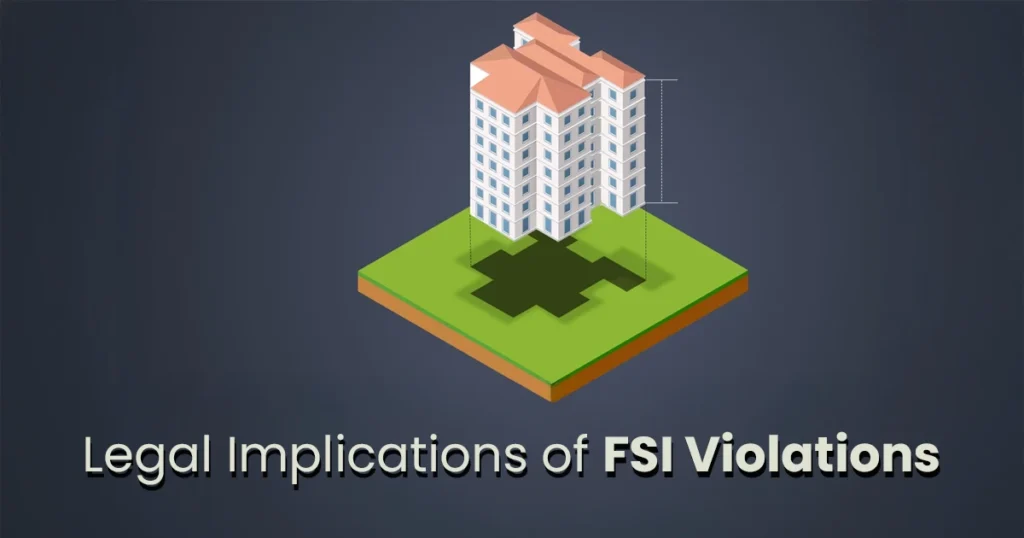
Exceeding permissible FSI constitutes a legal offence.
Consequences can include:
- Heavy monetary penalties
- Refusal of occupancy or completion certificates
- Demolition of unauthorized construction
- Litigation and delays to the project
Thus, due diligence on permissible FSI becomes a prerequisite before buying land or undertaking construction.
Conclusion: Floor Space Index
This understanding of FSI construction is critical in real estate development for the preparation of any necessary permits and design approval.
Consequently, FSI is an important factor in designing functional, sustainable, and livable cities, thus allowing a good balance between development intensity and the capacity of infrastructure. In this regard, FSI continues to be one of the most critical factors affecting any decisions made by real estate experts during the assessment of planning application submissions and development projects.
FAQ’s
How is fsi calculated?
This formula determines the FSI by dividing the total built-up area by the total plot area.
What is the floor space index?
Floor space index is legally possessed by the states as it defines the limit of constructing on a plot in their planning statute.
What is the FSI for 3000 square feet?
For a 3000-square-foot plot, the built-up area permissible on it will depend on the FSI allowed. For example, if an FSI is 1.8, you may go ahead and construct up to 5400 sq ft.
What is the FSI allowed in Bangalore?
Generally, in Bangalore, FSI is made available between 1.0 and 2.25, which depends on the type of road width, zoning codes, and land use classification.
Why is the FSI important?
FSI administers urban densification, contributes to basic service and infrastructure planning, secures the property value, and ensures managed as well as lawful development.